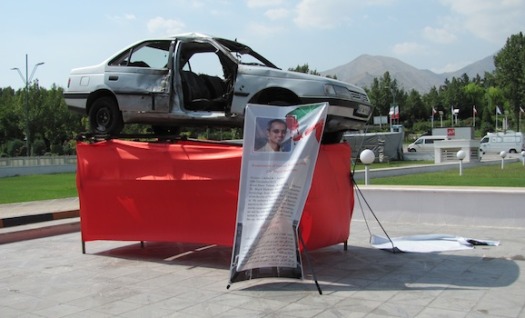
The car in which an Iranian nuclear scientist was killed is displayed atop a platform at the Islamic Republic of Iran Broadcasting Conference Center (Photo: Barbara Slavin)
1250 GMT: Summit Watch. A snapshot from journalist Thomas Erdbrink via Twitter, "Tehran is practically deserted during #NAM conference. Had to walk 2 miles before finding a cab. #Iran #hot"
1220 GMT: Foreign Affairs Watch (Egyptian Front). Iran's claims of diplomatic victories just keep coming --- State news agency IRNA is asserting, from an official at the Egyptian Council for Foreign Affairs, that Cairo will soon open an embassy in Tehran.
Yousry Abu Sahdy reportedly added that Egyptian President Morsi and Foreign Minister Mohamed Kamel Amr's participation in the Non-Aligned Movement's summit will strengthen diplomatic and economic ties between the two countries.
1135 GMT: Foreign Affairs Watch (Syrian Front). Farnaz Fassihi of the Wall Street Journal picks up on the comment of Revolutionary Guards commander Salar Abnoush --- noted in EA's Live Coverage on Monday --- "Today we are involved in fighting every aspect of a war, a military one in Syria and a cultural one as well."
Fassihi goes much farther, however, "Iran is sending commanders from its elite Iranian Revolutionary Guard Corps and hundreds of foot soldiers to Syria, according to current and former members of the corps."
Fassihi relying on exiled former Guards commander Mohsen Sazegara and "two people in the IRGC familiar with the movements", continues:
Iran is now sending hundreds of rank-and-file members of the IRGC and the Basij — a plainclothes volunteer militia answering to the Guards — to Damascus....Many of the Iranian troops hail from IRGC units outside Tehran, these people say, particularly from Iran's Azerbaijan and Kurdistan regions where they have experience dealing with ethnic separatist movements. They are replacing low-ranking Syrian soldiers who have defected to the Syrian opposition, these people said, and mainly assume non-fighting roles such as guarding weapons caches and helping to run military bases.
Iran is also deploying IRGC commanders to guide Syrian forces in battle strategy and Quds commanders to help with military intelligence, Mr. Sazegara and the current IRGC members said.
Fassihi further claims, "Iran has also started moving military aid and cash to Syria through Iranian companies in Iraq, such as a construction company owned by a former [Guards] member now living in Iraq and a tour company servicing pilgrims to holy Shiite sites."
1045 GMT: Summit Watch. United Nations spokesman Martin Nesirky has said UN Secretary General Ban Ki-moon will meet the Supreme Leader and President Ahmadinejad during his visit to Iran for the summit of the Non-Aligned Movement.
Nesirky said that the Secretary General will also hold talks with a number of Iranian lawmakers. Reports on Monday indicated Ban would see Speaker of Parliament Ali Larijani.
1035 GMT: Economy Watch. The number of registered orders for importing goods has fallen about 20%, Majid Reza Hariri of the Iranian Chamber of Commerce has said.
Hariri attributed the reduction to cumbersome procedures at customs and the unfair method of allocating foreign currency to importers.
Imports have risen sharply in price with the halving of the value of Iran's currency since last summer, and tightening sanctions have further restricted goods coming into the country.
1015 GMT: We begin with the rituals of propaganda around the Non-Aligned Movement's summit in Tehran, drawing from Barbara Slavin's first-hand report:
Tehran is festooned with colored lights, security personnel and placards hailing the non-aligned grouping — which originated in the days of East-West Cold War divisions — as “a symbol of independence throughout the world.” Other posters and banners proclaim “nuclear energy for everyone” — a pushback against six UN Security Council resolutions and innumerable US and European sanctions that penalize Iran for enriching uranium and failing to answer questions about possible military dimensions of its nuclear program.The most graphic display confronts visitors to the Islamic Republic of Iran Broadcasting Conference Center. There, atop platforms draped in blood-red fabric, are the mangled cars in which three Iranian nuclear scientists were killed in recent years. Israel has been blamed for the assassinations, in which magnetic bombs were attached to the windows of the cars the scientists were driving as they commuted through Tehran’s congested streets. Beside the cars are posters with pictures of the dead men and the circumstances of their deaths.
Inside the hall, reporters must run a gauntlet of posters describing other terrorist attacks against Iranian officials since the days of the 1979 Islamic Revolution. Many of them are devoted to the crimes of the Mujahedin-e Khalq, a radical group that lost out in the post-revolution power struggle and that has been lobbying aggressively to get off a US State Department list of terrorist organizations.
Meanwhile, there is a reaffirmation from the Iranian envoy to the International Atomic Energy Agency, Ali Asghar Soltanieh: "Our enrichment activities will never stop and we are justified in carrying them out, and we will continue to do so under IAEA supervision."
Ali Asghar Soltanieh continued, "We will not give up our inalienable right to enrichment."
Posted via email from lissping


No comments:
Post a Comment
Note: only a member of this blog may post a comment.